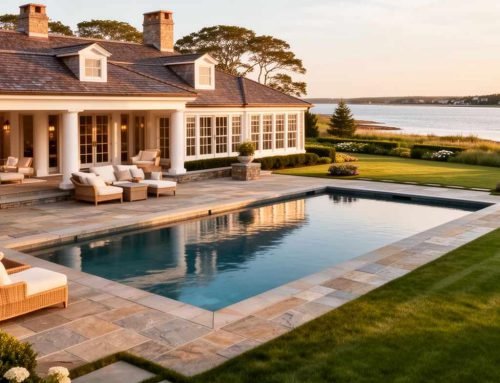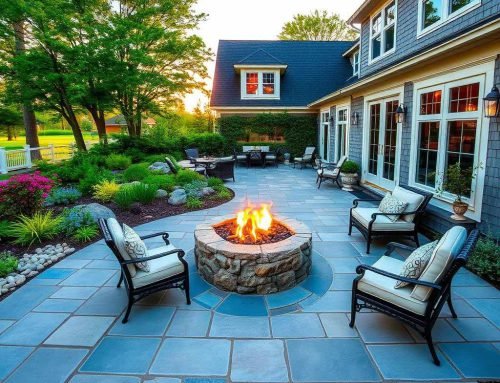
There is a particular quality that the finest Martha's Vineyard properties share. Walk the grounds of any estate that has been well-kept for decades and you will find it: a hardscape that looks as though it grew from the land rather than being placed upon it. Stone paths that follow the natural grade. Terraces that open toward the water as if the architect understood the view before drawing a single line. Walls that have weathered thirty New England winters without shifting an inch.
That quality is not accidental. It is the result of correct material selection, sound engineering, and the kind of craftsmanship that treats every placement decision as permanent — because it is.
What the Coastal Environment Demands
Martha's Vineyard presents hardscape challenges that mainland contractors routinely underestimate. Salt-laden air accelerates the oxidation of ferrous materials and the spalling of insufficiently dense stone. Sandy coastal soils shift with seasonal moisture changes in ways that clay-heavy inland soils do not. The island's freeze-thaw cycles — moderated by the surrounding water but never eliminated — exert pressure on any base that was not compacted and graded to engineering tolerances.
The consequence of ignoring these conditions is visible across the island: patios that heave after two winters, retaining walls that lean before the fifth season, walkways whose joints have opened wide enough to catch a heel. These are not failures of ambition. They are failures of knowledge — specifically, the knowledge of what this particular place demands from the ground up.
At LandMasters, sixteen years of working exclusively on Martha's Vineyard has given us an understanding of the island's terrain that informs every project we undertake. We know which areas drain freely and which retain water beneath the surface. We know how the ground behaves in the spring thaw along the south shore versus the more exposed north-facing properties. We know which stone suppliers consistently deliver material of the density and character that coastal conditions require.
A stone that was formed under conditions of extraordinary pressure and time does not fail under conditions of coastal salt air and New England winters. That is what it was made for.
Natural Stone vs. Manufactured Alternatives
Concrete pavers perform predictably in controlled conditions and deteriorate predictably when those conditions deviate from the manufacturer's assumptions. Coastal salt air, ground movement, and the particular UV exposure of an island environment accelerate the fading, efflorescence, and joint failure that eventually require significant remediation.
Natural stone — granite, bluestone, fieldstone — behaves differently. Its density is not manufactured; it is geological. Salt air does not degrade it. UV exposure does not fade it. A correctly set granite step on a Martha's Vineyard property will look better in twenty years than it did on installation day, as the stone develops the particular patina that makes historic island estates so compelling.
The Foundation No One Sees
The most important work in any hardscape project happens below the surface, where no one will ever see it. Base preparation — the excavation depth, the compaction method, the gravel specification, the drainage provision — determines whether a patio holds its level for decades or begins to shift within a few seasons.
On Martha's Vineyard, proper base preparation must account for the island's sandy subsoils, the proximity of the water table in coastal areas, and the weight and thermal mass of the stone above. A base that is built correctly the first time is invisible and permanent. A base that is built incorrectly becomes visible within a few winters and expensive to correct.
Design That Belongs to the Island
The island has a character — weathered cedar, native grasses, fieldstone walls that predate the Revolution — and landscape work that ignores that character in favour of trends imported from elsewhere will always look out of place, regardless of the quality of the materials used.
The hardscape we design at LandMasters is informed by the vernacular of the island. We favour stone that reads as native: the warm greys of local granite, the subtle blue-green of quarried bluestone, the irregular faces of hand-selected fieldstone. We create outdoor spaces that feel like extensions of the property's history rather than additions to its present.
What a Long-Term Investment Looks Like
A correctly designed and executed hardscape on a Martha's Vineyard property should require no significant intervention for twenty to thirty years. The occasional repointing of mortar joints. The seasonal clearing of debris from drainage channels. The kind of maintenance that takes an afternoon rather than a contractor.
That standard is achievable. We hold every project we build to it. And because we work exclusively on this island, with the same suppliers, the same subsoils, and the same coastal conditions year after year, we have the accumulated knowledge to deliver it consistently.
Begin Your Project
Discuss Your
Hardscape Project
We visit every property before proposing any work. Contact us to arrange a site consultation.